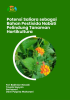
Potensi Saliara sebagai Bahan Pestisida Nabati Pelindung Tanaman Hortikultura
Synopsis
SPESIFIKASI BUKU
Harga : Rp 45.000
Ukuran : 14,8 cm x 21 cm
Jumlah Halaman : 94 hal
Ketebalan Buku : 1 cm
ISBN : On Proses
Deskripsi Buku : Buku ini disusun dengan tujuan untuk mengedukasi masyarakat untuk mengurangi bahkan berhenti menggunakan pestisida sintetik dan beralih pada penggunaan pestisida berbahan dasar botani yang tidak berisiko bagi kesehatan masyarakat maupun kesehatan lingkungan. Besar harapan penulis melalui buku kecil ini dapat memberikan dampak yang besar, mampu mengubah paradigma masyarakat tentang pestisida nabati dan senantiasa melakukan inovasi terkait jenis pestisida yang digunakan sehingga memperkaya pengatahuan akan manfaat tumbuhan sebagai bahan pestisida nabati yang dapat digunakan untuk mengendalikan hama yang lebih ramah lingkungan dibanding pestisida sintetik.
REFERENSI
Alemayehu Hailu Welderufael. (2016). Assessment of horticultural crops (vegetables, tubers & fruits) production constraints and opportunities in West and Southwest Shewa Zones of Oromia Region, Ethiopia. International Journal of Agricultural Economics, 1(3), 84–90. https://doi.org/10.11648/j.ijae.20160103.16
Andrian. (2022). Pola aktivitas harian dan dinamika populasi lalat buah (Bactrocera spp) pada pertanaman jambu madu thongsamsi (Syzygium aqueum) di Desa Jati Kesuma Kecamatan Namorambe Deli Serdang (pp. 1–71). Universitas Medan Area.
Dhillon, M. K., Singh, R., Naresh, J. S., & Sharma, H. C. (2005). The melon fruit fly, Bactrocera cucurbitae: A review of its biology and management. Journal of Insect Science, 5(1), 1–16. https://doi.org/10.1093/jis/5.1.40
Djatmiadi, & Djatnika. (2001). Petunjuk teknis surveilans lalat buah. Pusat Teknik dan Metode Karantina Hewan dan Tumbuhan, Badan Karantina Hewan dan Tumbuhan.
Drew, R. A. I., & Hancock, D. (1994). The Bactrocera dorsalis complex of fruit flies (Diptera: Tephritidae: Dacinae) in Asia. Bulletin of Entomological Research Supplement, (2), 68.
Ghisalberti, E. L. (2000). Lantana camara L. (Verbenaceae). Fitoterapia, 71(5), 467–486. https://doi.org/10.1016/S0367-326X(00)00202-1
Gupta, I., Singh, R., Muthusamy, S., Sharma, M., Grewal, K., Singh, H. P., & Batish, D. R. (2023). Plant essential oils as biopesticides: Applications, mechanisms, innovations, and constraints. Plants, 12(16), 1–29. https://doi.org/10.3390/plants12162916
Hasinu, J. V., & Tuhumury, G. N. C. (2025). Diversitas dan kelimpahan lalat buah (Bactrocera sp.) terhadap kerusakan tanaman tomat (Solanum lycopersicum L.). Jurnal Pertanian Kepulauan, 9(1), 34–41. https://doi.org/10.30598/jpk.2025.9.1.34
Hasyim, A., Lukman, L., & Setiawati, W. (2020). Teknologi pengendalian hama lalat buah. IAARD Press.
Indriyanti, R. D. (2022). Identifikasi dan kelimpahan lalat buah Bactrocera pada berbagai buah terserang. Journal of Biology & Biology Education, 6(1), 39–44. http://journal.unnes.ac.id/nju/index.php/biosaintifika
Kusumawati, D. E., & Istiqomah. (2022). Pestisida nabati sebagai pengendali OPT (Organisme Pengganggu Tanaman). Madza Media.
Larasati, A., Hidayat, P., & Buchori, D. (2016). Kunci identifikasi lalat buah (Diptera: Tephritidae) di Kabupaten Bogor dan sekitarnya. Jurnal Entomologi Indonesia, 13(1), 49–61. https://doi.org/10.5994/jei.13.1.49
Li, X., Li, P., Li, D., Cai, X., Gu, S., Zeng, L., Cheng, D., & Lu, Y. (2024). Dynamics of Bactrocera dorsalis resistance to seven insecticides in South China. Insects, 15(9). https://doi.org/10.3390/insects15090679
Liwa Ilhamdi, M., Al Idrus, A., & Syazali, M. (2025). Kelimpahan lalat buah (Bactrocera sp.) di perkebunan buah Desa Batu Mekar, Lingsar, Lombok Barat. BIOCHEPHY: Journal of Science Education, 5(1), 32–41. https://doi.org/10.52562/biochephy.v5i1.1404
Moretti, M. D. L., Sanna-Passino, G., Demontis, S., & Bazzoni, E. (2002). Essential oil formulations useful as a new tool for insect pest control. AAPS PharmSciTech, 3(2). https://doi.org/10.1208/pt030213
Muryati, M., Trisyono, Y. A., Witjaksono, W., & Wahyono, W. (2017). Oviposition deterrent of Bactrocera carambolae resulted from eggs deposition on mango. Agrivita, 39(2), 201–213. https://doi.org/10.17503/agrivita.v39i2.1097
Nawaz, A., Ayub, M. A., Nadeem, F., & Al-Sabahi, J. N. (2016). Lantana (Lantana camara): A medicinal plant having high therapeutic potentials—A comprehensive review. International Journal of Chemical and Biochemical Sciences, 10(1), 52. www.iscientific.org/Journal.html
Oladoye, S. O. (2021). Lantana camara: Phytoconstituents and antimicrobial activity study. Pan African Journal of Life Sciences, 5(2), 289–298. https://doi.org/10.36108/pajols/1202.50.0270
Raghuvanshi, A., Satpathy, S., & Mishra, D. (2012). Role of abiotic factors on seasonal abundance and infestation of fruit fly, Bactrocera cucurbitae (Coq.) on bitter gourd. Journal of Plant Protection Research, 52(2), 264–267. https://doi.org/10.2478/v10045-012-0042-3
Raghuvanshi, S. K., Ahmad, B., Siddhartha, Srivastava, A. K., Krishna, J. B. M., & Wahab, M. A. (2012). Effect of gamma irradiation on the optical properties of UHMWPE (ultra-high-molecular-weight-polyethylene) polymer. Nuclear Instruments and Methods in Physics Research Section B, 271, 44–47. https://doi.org/10.1016/j.nimb.2011.11.001
Regnault-Roger, C., Vincent, C., & Arnason, J. T. (2012). Essential oils in insect control: Low-risk products in a high-stakes world. Annual Review of Entomology, 57, 405–424. https://doi.org/10.1146/annurev-ento-120710-100554
Riffell, J. A., Alarcón, R., Abrell, L., Davidowitz, G., Bronstein, J. L., & Hildebrand, J. G. (2008). Behavioral consequences of innate preferences and olfactory learning in hawkmoth-flower interactions. Proceedings of the National Academy of Sciences, 105(9), 3404–3409. https://doi.org/10.1073/pnas.0709811105
Rinaldi, F. B., Sopyan, T., & Nurfadilah, A. (2024). Potensi buah berenuk sebagai pengendali hama pada tanaman sawi yang ramah lingkungan. Perkumpulan Rumah Cemerlang Indonesia.
Rinaldi, F. B., Udiarto, B. K., & Rachmawati, J. (2016). Pengaruh ekstrak bunga krisan (Chrysanthemum cinerariaefolium Trev.), bunga saliara (Lantana camara Linn.), dan bunga lavender (Lavandula angustifolia Mill.) terhadap repellency kutu kebul (Bemisia tabaci Genn.). Bioed: Jurnal Pendidikan Biologi, 4(1), 41–49.
Sahetapy, B., Uluputty, M. R., & Naibu, L. (2019). Identifikasi lalat buah (Bactrocera spp.) pada tanaman cabai (Capsicum annum L.) dan belimbing (Averrhoa carambola L.) di Kecamatan Salahutu, Kabupaten Maluku Tengah. Agrikultura, 30(2), 63. https://doi.org/10.24198/agrikultura.v30i2.23659
Sarwar, M., Hamed, M., Rasool, B., Yousaf, M., & Hussain, M. (2013). Host preference and performance of fruit flies Bactrocera zonata (Saunders) and Bactrocera cucurbitae (Coquillett) (Diptera: Tephritidae) for various fruits and vegetables. International Journal of Scientific Research in Environmental Sciences, 1(8), 188–194. https://doi.org/10.12983/ijsres-2013-p188-194
Siwi, S. S., & Hidayat, P. (2004). Taksonomi dan bioekologi lalat buah penting (Diptera: Tephritidae). Balai Besar Penelitian dan Pengembangan Bioteknologi dan Sumberdaya Genetik Pertanian.
Untung, K. (2003). Pengantar pengelolaan hama terpadu (Revisi 2003). Yogyakarta: Gadjah Mada University Press.
Ye, H., & Liu, J. (2007). Population dynamics of oriental fruit fly Bactrocera dorsalis (Diptera: Tephritidae) in Xishuangbanna, Yunnan Province, China. Frontiers of Agriculture in China, 1(1), 76–80. https://doi.org/10.1007/s11703-007-0014-y
Yudistira, D. H., Tanjung, I. S., & Rizkie, L. (2020). Preferensi inang lalat buah Bactrocera cucurbitae (Coquillet) dan Bactrocera dorsalis (Hendel) pada berbagai jenis buah. Bioma: Jurnal Ilmiah Biologi, 9(2), 189–198. https://doi.org/10.26877/bioma.v9i2.7058
Zulkarnain, Z. (2013). Dasar-dasar hortikultura. Jakarta: Bumi Aksara.
Published
September 23, 2025
Copyright (c) 2025 Perkumpulan Rumah Cemerlang Indonesia
Details about the available publication format: Pratinjau Buku
Pratinjau Buku
Physical Dimensions
Details about the available publication format: Beli Buku
Beli Buku